
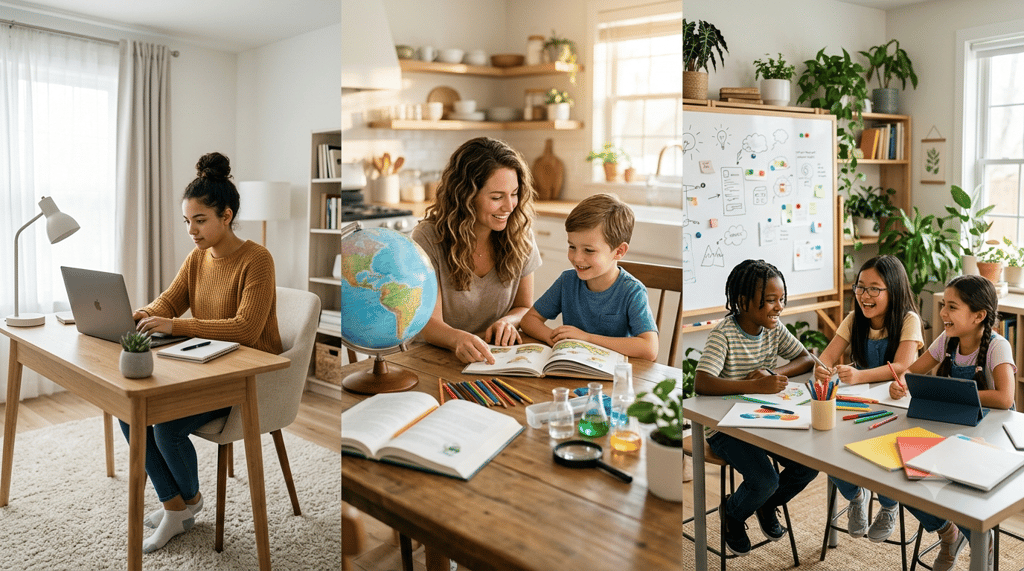
Online School vs Homeschool vs Microschool: A 2026 Comparison
Online School vs Homeschool (vs Microschool): 2026 Guide
What is the difference between online school, homeschool, and microschool?
An online school is an accredited institution — public or private — where teachers deliver curriculum over the internet. Homeschool is when a parent is legally and educationally responsible for teaching, even with bought curriculum or hired tutors. A microschool is a small, in-person learning community of usually under 25 students with a paid facilitator. Cost, accreditation, social structure, and required parent time all follow from one question: who owns responsibility for the education — an institution, a parent, or a small community? The short version of online school vs homeschool: an online school is run by an institution; a homeschool is run by a parent; a microschool is run by a small community of facilitators in person.
Once you see the question that way, most of the comparison clears up.
Why parents are comparing online school vs homeschool in 2026
Three numbers explain the shape of this conversation.
In EdChoice's 2025 Schooling in America Survey, 59% of K-12 parents said American education is "on the wrong track." The National School Choice Awareness Foundation's January 2024 survey of 2,595 parents found that 72% had considered new schools for their children in the previous year — up from 52% in 2022. That is a twenty-point swing in two years. The category of parents who treat the local public school as the obvious default has shrunk noticeably, and the parents who left the default are now actively shopping.
Shopping for what? Each of the three alternatives has grown.
Roughly 950,000 K-12 students are now enrolled full-time in online schools per the NCES 2022–23 PFI survey, with the National Education Policy Center counting full-time virtual public school enrollment in the hundreds of thousands. The federal NCES Parent and Family Involvement in Education Survey put homeschooling at 3.4% of school-age children in 2022–23, with an additional 1.8% in full-time virtual education — roughly 1.8 million homeschoolers and 950,000 virtual-school students combined. The National Home Education Research Institute estimates the real homeschool number is closer to 3.4 million (6.26%) in 2024–25, drawing from a wider methodology. Both numbers are defensible. Both come with caveats. The honest move is to acknowledge the gap rather than pick the more flattering one. Microschools — small, in-person communities that barely registered as a category a decade ago — now serve somewhere between 750,000 and 2.1 million students according to RAND's 2025 sector analysis, with the National Microschooling Center's 2024–25 American Microschools Sector Analysis drawing on responses from roughly 800 microschool leaders across all 50 states.
A consideration set this wide is new. So is the confusion that comes with it.
Most parents looking at this category for the first time use the three terms interchangeably. They are not interchangeable. A family using K12.com curriculum at the kitchen table is legally homeschooling in most states. A microschool that uses an online private school as its curriculum spine is both an in-person community and an enrollment in a school. A cyber charter is a public school your child attends from your living room, not homeschool. These distinctions matter because they control who issues the transcript, who is legally accountable, what regulators expect, and where the actual costs land.
Here is the reframe that organizes the rest of this article. One question controls almost everything else in this comparison — who is responsible for your child's education: an institution, you, or a small community of facilitators. The structural answer to that question determines cost, social structure, parent time, accreditation, and college path.
Lock the definitions down first. The comparison table follows.
The three categories, defined precisely
Most of the confusion in this space lives in imprecise definitions. Lock these down before the comparison.
Online school is an accredited institution that delivers instruction online. The institution enrolls the student, employs the teachers, designs (or licenses) the curriculum, and issues the diploma. There are two important sub-types, and the difference is structural.
A virtual public school is the online arm of a state public school system — free, state-funded, state-curriculum, state-certified teachers. Examples include K12 Stride's public partnerships, the public-funded arms of Connections Academy, and most "cyber charters." Enrollment is usually restricted to in-state students. Cohorts are large, instruction is often asynchronous, and the student population is the broadest mix you can imagine.
An online private school is a tuition-funded independent school that happens to deliver online. It sets its own admissions standards, designs its own program, hires its own faculty, and answers to the accrediting body it chose rather than to a state board. Examples include Stanford Online High School, Laurel Springs, Pearson Online Academy, K12 Private Academy, and Sora. The tuition range runs from about $3,500 at the cheapest self-paced end to roughly $30,000 at the most selective seminar-based end. Quality and price correlate loosely at best — a $13,000 program with live seminars often outperforms a $20,000 program built on recorded lectures.
Homeschool is the model where the parent is the legal teacher of record. The parent is responsible for instruction, recordkeeping, and (in most states) some form of compliance with state homeschool law. The actual day-to-day teaching can come from anywhere — textbooks, online curriculum providers like Time4Learning or Khan Academy, hired tutors, co-ops, microschools, course marketplaces like Outschool, or the parent's own subject expertise. What determines whether something counts as homeschooling is the legal frame — who is the teacher of record — regardless of what materials the family uses. A family using K12.com curriculum at the kitchen table is typically still legally homeschooling. A family whose child is enrolled in a virtual charter is not.
The state-by-state legal landscape is sharp here. The Home School Legal Defense Association and the Coalition for Responsible Home Education agree on the facts even though they disagree on policy. Eleven states require no notification from homeschool families. About a dozen require notification plus periodic assessment. Five — New York, Pennsylvania, Rhode Island, Vermont, and Massachusetts — require notice, curriculum lists, regular testing, and progress reports. Only 31 states require specific core subjects. The regulatory floor varies enormously, and the floor matters because it shapes what bad-actor families can do and what good-faith families have to document.
Microschool is a small, in-person learning community, usually under 25 students, with a paid facilitator or teacher. The legal structure varies — some are licensed private schools, some are homeschool co-ops, some operate under an accredited umbrella school, some are hybrid programs that mix in-person time with online instruction. Examples include Prenda, KaiPod Learning, Acton Academy (whose locations vary in size from microschool-sized to larger), Outschool's microschool initiative, and thousands of independent operators. The unifying features are scale (small), modality (in-person), and design (intentionally personalized).
A few muddy cases worth naming directly.
A family using K12.com curriculum at the kitchen table while the parent supervises is legally homeschooling, even though "the kid is on a screen all day" looks like online school to a neighbor. The screen does not change the legal frame; the parent is still the teacher of record.
A microschool that uses Sora or another online private school as its curriculum spine — the KaiPod model — is both a microschool (small in-person community) and an enrollment in an online private school (accredited diploma, employed teachers, designed program). The diploma comes from the online school. The daily community is the microschool.
A cyber charter is a public school you do at home, not homeschool. The state employs the teachers, the state issues the diploma, the state is on the hook for outcomes. The parent supervises but is not legally teaching.
The legal layer matters more than it looks. It controls who gives the transcript, who is accountable for outcomes, what regulators expect of you, and which research applies to your situation. Studies of "homeschool outcomes" are mostly drawn from families where a parent designed the program; studies of "online school outcomes" are mostly drawn from cyber charters. Generalizing across the categories without the legal frame produces nonsense.
With the categories defined, the comparison is finally honest.
Online school vs homeschool vs microschool: side-by-side comparison
The single thing every vendor article in the SERP refuses to publish is the table that lets you compare across all the dimensions parents actually care about. Here it is.
DimensionVirtual public schoolOnline private schoolHomeschoolMicroschoolTraditional public schoolAnnual costFree$3,500–$30,000 (typical $5K–$15K)$500–$2,500 direct (plus 5–40+ parent hours/week)$5,000–$15,000FreeWho designs the curriculumState-mandatedThe schoolParent (often using purchased curriculum)The microschool or umbrellaState + districtWho teachesState-certified employeesSchool-employed teachersParent (often with outside help)Paid facilitatorDistrict-employed teachersStudent-teacher ratio~34:1 (NEPC 2021)8–20 typical at strong programs1:1 to small family groupMedian 22 students/program (EdChoice/KaiPod 2025)~15.4:1 nationally (NCES)Live instructionLimited; often asynchronousCore of the model at well-designed programsParent-led, real-time at homeDaily, in-personDaily, in-personAccreditation typicalState public-school accreditation (automatic)Cognia, WASC, MSA-CESS, NEASCNone as such (parent transcript)Varies — some accredited, some under umbrella, some notState public-school accreditationSocial structureLimited; large cohorts, asynchronousDesigned cohorts, advisors, online community, regional meetupsBuilt through co-ops, sports, community, family-arrangedIn-person, small group, consistent peer cohortIn-person, school-definedGeographic flexibilityNone (in-state only)Full — accepts students globallyFullNone (must be near the program)NoneParent time required per weekModerate (supervising)Low (program runs it)High — 5–10 hrs/week elementary, 20+ hrs/week high schoolLow (program runs it)LowOversight / state regulationHigh (public funding)Light (accreditor-mediated)Varies from none to extensiveVariesHighCollege admissions pathAccredited diplomaAccredited diplomaParent transcript — documentation-heavy for selective collegesDepends on accreditation/umbrellaAccredited diplomaEvidence base / outcomes dataStrong — and largely negative (CREDO: 180 lost days of math/year; NEPC 2021: 65.1% grad rate)Wide range; most programs don't publishVolunteer-sample studies show positive results with severe selection biasRAND 2024: "nearly impossible" to determine; high parent satisfactionDecades of data; large variance by district
Tuition ranges per published school tuition pages; the benchmark for traditional in-person private school is $14,903 per EducationData.org.
Three things in this table surprise most parents.
First, the price gap between online private school and microschool is narrower than people assume. Many online private schools cost roughly what an in-person microschool costs in the same family's region — sometimes less. The free option (cyber charter) sits next to the by-far-most-expensive option (traditional in-person private) on a different axis from quality.
Second, homeschool's headline cost — about $500 to $2,500 per child per year in direct curriculum and materials per Tutors.com cost surveys — looks like the cheapest option. Hidden cost flips that. Homeschool typically requires 5 to 10 hours per week of parent time at elementary level and 4 to 6 hours per day at high school level. Most cost comparisons silently treat parent time as free. It is not.
Third, the cyber-charter graduation rate is the data nobody puts in these comparisons. The National Education Policy Center's 2021 Virtual Schools report found a 65.1% four-year graduation rate at full-time virtual schools, against an 86.5% national average. For-profit virtual schools: 48.5%. Cyber charters specifically: 59.4%. The student-teacher ratio in nonprofit cyber schools sits at 34:1 versus 16:1 in traditional public schools. The mechanism for the gap is not mysterious.
Each option deserves a closer look — strengths and weaknesses both.
Online school: virtual public, online private, and why the difference matters
The single largest mistake parents make in this comparison is treating "online school" as one category. It is not. Virtual public school and online private school are different products built for different students with different evidence bases.
Start with the harder evidence first.
The CREDO Online Charter School Study at Stanford remains the most rigorous large-scale evaluation of full-time virtual public schools. The 2015 study compared online charter students to matched peers in brick-and-mortar schools. The findings were catastrophic. Students at full-time online charters lost the equivalent of 180 days of learning in math and 72 days in reading per year compared to matched peers. Eighty-eight percent of online charters underperformed brick-and-mortar peers in math. In no state did online charter students outperform peers in both math and reading. The NEPC's 2021 Virtual Schools report extends the picture with the graduation data above — 65.1% versus 86.5% nationally, with for-profit virtual schools coming in at 48.5% and a 34:1 nonprofit cyber-school ratio versus 16:1 in traditional public schools. The NEPC's more recent annual reports continue to find virtual schools underperforming on the same directional measures.
This is the evidence that no top-ranked vendor article cites. It is also the evidence that should not be hand-waved.
The mechanism for the catastrophe is also not mysterious. Self-Determination Theory — developed by Edward Deci and Richard Ryan and updated in 2020 in Contemporary Educational Psychology — identifies three universal psychological needs that predict whether learning environments produce engaged learners or disengaged ones: autonomy (meaningful choice over what and how to learn), competence (appropriate challenge and visible progress), and relatedness (genuine connection to people who matter). A 34:1 ratio crushes relatedness. Asynchronous video — no teacher noticing when a student checks out, no scaffolding when one gets stuck — kills competence. And the state-mandated curriculum leaves autonomy nowhere to land. All three needs unmet, simultaneously. The motivation collapse is the predictable consequence of the design, not a mysterious failing of the students.
A few important caveats. The CREDO data is about cyber charters — large, mass-scale, often for-profit, public-funded. Generalizing from K12 Stride to Stanford Online High School is the equivalent of judging every restaurant in America by drive-through performance. The model, the population, and the price all differ. But the warning is real for the model that data describes. A free, asynchronous, state-curriculum online school with a 34:1 ratio is the worst-evidenced model in the comparison. Parents drawn to virtual public school by the price tag should weigh that price against the outcome data, not against in-person school in the abstract.
Online private school is a different product entirely. Tuition ranges from about $3,500 to $30,000 per year, with cohorts that can be small and instruction that can be live. The school designs its own curriculum, hires its own faculty, and answers to the accreditor it chose. The quality range within the category is staggering — from rebranded textbook publishers with no live instruction to seminar-based programs with twelve-student classes and PhD faculty.
The named examples roughly span the price ladder. Sora runs $4,800–$9,600 on income-flexible tuition. Laurel Springs Academy runs about $13,000. Pearson Online Academy and K12 Private Academy fall in similar ranges. Stanford Online High School sits at roughly $30,000. Stanford OHS publishes a full college acceptances page — mean SAT 1499 for the class of 2025, with 2023–2025 cumulative matriculations including Stanford (17), MIT (11), and UC Berkeley (14). Most online private schools do not publish anything like that, and the silence is itself information.
What works in this category, mechanism-wise, is the inverse of what fails in cyber charters. Small live cohorts produce the relatedness CREDO found missing. Structured choice within a designed curriculum supports autonomy without descending into the chaos of pure self-pacing. Live teachers who know each student's name scaffold competence in a way no recorded video can. Project-based work produces visible outputs — a podcast, a blueprint, a campaign, a research paper — that make competence observable in a way a percentage on a worksheet does not. When an online private school delivers all three Self-Determination needs deliberately — Stanford OHS at 12-student seminars and Sora's cohort model are the two clearest public examples — the available outcome data suggests the results look closer to strong independent schools than to cyber charters.
When an online private school is just a digitized textbook with a transcript stapled on, the outcomes look closer to cyber charter. The category contains both products. The website language is identical across them.
Questions worth asking any online private school: How many hours per week of live instruction? What is the student-to-teacher ratio in academic classes? Does each student have a named advisor with a defined meeting cadence? What is the published four-year graduation rate? What did the most recent graduating class do next? Programs proud of their teaching answer in concrete detail. Programs that don't answer concretely have a reason.
A deeper guide to that evaluation lives in Sora's online private school parent guide, which covers the accreditation question, the screen-time tradeoffs, and the red-flag patterns in more detail. The short version: accredited diploma, live instruction, small cohorts, named advisor, published outcomes, designed community. Anything less is something else.
That covers the institutional path. The other major option is doing it yourself.
Homeschool: what the data says, and where the data fails
Homeschool is the category where the research is the loudest and also the most epistemically tangled. Both deserve honesty.
The most-cited research case for homeschooling comes from Brian Ray's 2017 systematic review in the Journal of School Choice. Across 14 peer-reviewed academic-achievement studies, 11 showed positive effects; homeschoolers typically scored 15 to 25 percentile points above the public-school average on standardized tests. Across 15 social and emotional studies, 13 showed positive outcomes — better peer interaction, stronger self-concept, more leadership and community-service participation. The headline numbers look like a slam-dunk.
The caveat is severe. Almost all the studies in Ray's review use volunteer samples recruited through homeschool networks. The families who agreed to be studied are more engaged, higher-income, and higher-education than the average homeschool family — let alone the average American family. Selection bias of that magnitude does not invalidate the findings; it shifts what they mean. The honest interpretation, summarized by Richard Medlin in his 2013 Peabody Journal of Education review, is that "an alarmist view of homeschooling is not supported by empirical research," but that the methodology cannot establish causation. Medlin's review is the most balanced peer-reviewed source on homeschool research; he takes the question seriously and acknowledges its limits.
Translation: in the families and contexts where homeschooling is well-resourced — engaged parents, time, expertise, supplemental tutoring and co-ops, deliberate socialization — the outcomes are strong. The data cannot tell us how homeschooling works for the average family, the struggling family, or the family whose homeschool is unintentional or under-resourced. That is a genuine gap in the evidence base. It is also where the choice for any particular family lives.
The reasons parents homeschool have themselves shifted. NCES Parent and Family Involvement in Education data on reasons for homeschooling have consistently found that the large majority of homeschool parents cite school environment concerns (safety, drugs, peer pressure), moral instruction, dissatisfaction with academic instruction, and desire to emphasize family life, with religious instruction and a preference for non-traditional approaches still important but no longer dominant in isolation. The reasons stack. Most parents check multiple boxes. The "homeschooling for religious reasons" framing that dominated public perception twenty years ago is still partly true but no longer dominant.
The demographic picture has shifted further. Census Household Pulse data and NHERI's 2024–25 estimates put the homeschool population at roughly 68% White, 15% Hispanic, 8% Black, and 4% Asian — a mix that approximately mirrors the broader school-age population. Income distribution also roughly mirrors the broader population. The pre-pandemic stereotype of homeschooling as White, affluent, and religious is empirically outdated. Homeschool is now a cross-cutting choice across demographic lines, made for cross-cutting reasons.
Now the part of the analysis that vendor articles and homeschool advocacy sites both skip.
Homeschool's biggest hidden cost is parent time. Tutors.com puts direct material cost at roughly $500 to $2,500 per child per year. The number sounds small. It omits the structural cost of the parent's time and attention.
The average homeschooling parent reports 5 to 10 hours per week of direct instruction at elementary level. At high school, the number rises to 4 to 6 hours per day — chemistry, calculus, foreign languages, and AP-equivalent coursework either require parental subject expertise, time to acquire it, or money to outsource it. The cost calculation, run honestly, depends on what the parent could otherwise be doing with that time. For a parent with a flexible career and the relevant expertise, the opportunity cost is modest. For a single parent working full-time, or for a household where both parents work, the opportunity cost can be financially or practically prohibitive. NHERI's own COVID-era ProQOL research documented elevated burnout among pandemic-era homeschool parents, particularly those newer to the practice. The skill is real, not innate, and acquiring it takes time the new parent often does not have.
There is also a tail risk in the research that the homeschool advocacy world generally avoids and that vendor articles avoid for different reasons. A 2014 study by Barbara Knox and colleagues, published in the Journal of Child & Adolescent Trauma and frequently cited by the Coalition for Responsible Home Education, examined severe child torture cases and found that 47% of school-age victims had been removed from school to be homeschooled and another 29% had never been enrolled. Only one state currently prevents withdrawing a child from school to homeschool during an active abuse investigation. The vast majority of homeschool families are not abusive. The system-level concern is narrower and real: the regulatory floor in many states is low enough that bad actors can hide, and that floor matters even when it does not describe any particular family. Both CRHE and HSLDA, which sit on opposite sides of the regulation debate, agree on the underlying facts.
The other thing the most successful homeschoolers usually don't talk about as loudly as they should: they almost never homeschool alone. Co-ops, hybrid programs, course marketplaces, microschools, online classes, hired tutors, and occasional dual-enrollment with local colleges are the infrastructure that makes "homeschool" work at high school level. The serious homeschooler doing high-school chemistry is typically using a co-op chemistry class, an online lab simulation, an outside tutor, or all three. "Doing it well" usually involves significant outsourcing. The implication is that the cost numbers above understate the real cost of a high-quality homeschool program by a wide margin, and that the family time saved by not driving to a school building is partly spent driving to co-ops and tutors instead.
A practical guide to the operational side of all this lives in Sora's homeschooling guide. The honest bottom line: when the parent has the time, the expertise, and the disposition to design around the child's specific needs, homeschool can be extraordinary. When any of those three is missing, the model tends to break — quietly, in ways that don't show up in volunteer-sample research.
Which is one of the reasons the microschool emerged.
Microschool: small, in-person, and largely unmeasured
The microschool category barely existed as a named thing a decade ago. Today, between 750,000 and 2.1 million American students attend one, depending on how you count, across thousands of operating programs nationwide. EdChoice's surveys suggest somewhere between 10% and 14% of K–12 parents report enrolling a child in a microschool depending on definition. The growth is real. The research is not — at least not yet — sufficient to evaluate it.
Start with what a microschool actually is. Per the 2025 EdChoice/KaiPod Microschooling Survey, the median microschool size is 22 students for private operators and 36 for public-funded ones. Most are in-person, some are hybrid. Most have a paid facilitator or teacher. Many are multi-age. The named operators include Prenda, KaiPod Learning, Acton Academy, and Outschool's microschool initiative, plus thousands of independent programs. The legal structure varies: some are licensed private schools, some are homeschool co-ops, some operate under an accredited umbrella school, some are unaccredited.
The parent-satisfaction data is striking. The EdChoice/KaiPod survey found 76% of microschool parents "very satisfied," 17% "somewhat satisfied," and only 5% dissatisfied. Ninety-two percent reported consistent socialization opportunities. Seventy-six percent reported their child's sense of belonging changed "a great amount or a lot" after the move to microschool. Those numbers are higher than any K–12 setting in the EdChoice national surveys.
The fit with neurodivergent students is particularly clear in the data. The 2024–25 National Microschooling Center sector analysis — drawing on a survey of roughly 800 microschool leaders — found that 74% of microschools serve children with neurodiversities and 63% serve students academically below grade level. The mechanism is not subtle. A 22-student program with a consistent adult, flexible curriculum, sensory accommodations available on demand, and the ability to personalize pacing addresses needs the conventional 30-student classroom is built to fail.
Cost lands close to online private school. Most microschools charge between $5,000 and $15,000 per year. Some are below that range; very few are above it. The cost is roughly the same as a strong online private school; the in-person delivery is the upside, the geographic restriction is the downside.
Now the honest counterweight. The RAND Corporation's 2024 methodology report on microschools, led by Lauren Covelli and colleagues, concluded that determining microschool impact on student outcomes is "nearly impossible" with available data. The reasons are structural: small school size makes statistical inference hard, model variation across programs is enormous, and many microschool families deliberately avoid the standardized testing that would produce the comparison data. Parent satisfaction is high. Objective academic outcomes are scarce. Anyone confidently claiming microschools "outperform" traditional school is going beyond the evidence; anyone confidently claiming they "underperform" is doing the same.
The mechanism for why microschools probably work is the strongest part of the case. Small group plus consistent adult plus autonomy-supportive design is the cleanest Self-Determination Theory delivery vehicle in the comparison — all three needs (autonomy, competence, relatedness) addressed by the structure of the day. The empirical proof is thin. The theoretical case is strong. Parent reports are positive. That is the honest summary.
Two practical limits to weigh.
Geography is hard. A great microschool in Phoenix is not an option for a family in Pittsburgh. The structural cost of in-person delivery is that the family has to be near the program. Hybrid microschools that mix in-person time with online instruction soften this, but only somewhat.
Quality range is wide. There is no national quality floor for microschools. A microschool is only as good as its facilitator, and the facilitator population varies from former classroom teachers with deep expertise to enthusiastic parents with no instructional background. The right question for any microschool a family is considering: what is the facilitator's background, how long has the program operated, what curriculum does it use, and what do graduating students do next? An admissions team that answers in detail is one signal. An admissions team that answers vaguely is another.
With the three options on the table, the decision question gets sharper.
A decision framework: seven questions to ask yourself
The most useful frame is the one most comparison articles avoid: there is no universally best option here. There is a best option for your specific child, your parent capacity, and your family's credentialing needs. Seven questions narrow the field.
1. How many hours per week can a parent realistically commit to direct instruction?
This is the first filter and the one most parents underestimate. Under 5 hours per week of available parent time, homeschool is not viable as a primary model; it requires either an online private school or a microschool to do the academic lift. Between 5 and 15 hours per week, homeschool is possible with heavy co-op, tutor, or microschool support — or online private school with light parent involvement. Above 15 hours per week of available time, full homeschool becomes structurally viable. The number to be honest about is the sustainable hours per week, not the hopeful ones. A parent who can teach for 20 hours per week in October but burns out by February is in the under-5-hours category functionally, even if the calendar says otherwise.
2. What does your child need socially?
Daily in-person peer group: microschool or hybrid program. Live virtual community is sufficient: online private school with designed cohorts, clubs, and regional meetups. Family-and-community-arranged socialization through co-ops, sports, faith communities, and neighborhood friends: homeschool. The questions to ask honestly are how much in-person peer time your child needs to feel anchored, and what infrastructure exists in your community to provide it. Some children genuinely thrive with mostly virtual peer relationships supplemented by deep family connection. Others wilt without daily in-person contact. The temperament differs by child.
3. How much self-direction does your child currently have, and is the program built to grow it?
Highly self-directed teen: most options work, though pure self-paced cyber-charter content is still a poor design for almost anyone. Average-to-low self-direction: look for live instruction, named advisors, structured days, and concrete accountability — not pure flexibility marketed as "learn at your own pace." Self-paced anything is the wrong design for a kid who needs scaffolding. A program advertising maximum flexibility to a parent of a kid with executive function challenges is selling the wrong product to that family.
4. Do you need an accredited diploma now?
If your child is on a selective-college trajectory, the answer is usually yes. Accredited online private school produces a transcript that selective colleges treat identically to traditional ones. An accredited microschool — or a microschool operating under an accredited umbrella school — produces a transcript colleges accept directly. Homeschool transcripts carry a documentation friction tax: NACAC-style admissions-officer research consistently finds that roughly 33% of admissions officers rely most on portfolios for homeschoolers versus 10% for traditional applicants. The 2017 Rochester revoked-admission case showed what happens when that documentation comes up short. The path is open. The documentation burden is higher. Plan accordingly with SAT/ACT scores, external course grades, letters from non-parent instructors, and substantive portfolios.
5. How important is geographic flexibility?
Frequent moves, work travel, military families, full-time athlete or performer schedules: online private school is the only option that does not break under geographic pressure. Stable location: microschool opens up. Mixed: a hybrid that combines an online school's accredited diploma with a regional in-person community (the KaiPod model and others like it) can deliver both.
6. What is your budget — and what's your hidden cost tolerance?
Free with accepted academic risk: virtual public school. About $500 to $2,500 per year in direct cost plus substantial parent time: homeschool. $5,000 to $15,000 per year with the school doing the academic lift: online private school or microschool. Worth checking before deciding: does your state offer Education Savings Accounts, vouchers, or tax-credit scholarships that could be applied to online private school or microschool tuition? More than one million students now participate in private-school choice programs, up sharply since 2020, and many programs cover online enrollments.
7. Does your child have specific needs the model must address?
The data is clearest for neurodivergent and twice-exceptional profiles. The 74% / 63% microschool numbers above suggest microschools are unusually willing to serve kids the conventional system struggles with. Online private schools with small cohorts, flexible pacing, and sensory autonomy work well for many autistic and ADHD students — particularly those who find a 30-student classroom overstimulating. Homeschool works for families whose parents have the time and expertise to design around the child's specific profile. A competitive athlete or junior performer is usually best matched to online private school. A student in severe school refusal usually needs both a model change and clinical support, not just a model change. Each profile maps differently, and the mismatch cost is highest for these students.
The mechanism that ties all seven questions together is the same one: every model is a different bet on autonomy, competence, and relatedness. The right model is the one that most reliably delivers all three for your specific child, in your specific family situation, with the credentialing your specific path requires. No model wins this in the abstract. The one that fits wins.
When each option is the wrong fit
The other half of fit is naming where each model fails. This is the section vendor articles will not write.
When cyber charter is the wrong fit. Almost always for almost every student. The 34:1 ratio, asynchronous video, and standardized curriculum is the worst Self-Determination delivery vehicle in the comparison. The CREDO and NEPC data are not glitches in the system; they are the predictable outputs of the design. The students most likely to thrive in cyber charter — independently motivated, externally supported, with a parent actively engaged in daily structure — are the same students who would thrive in almost any environment. For most students who need human accountability, an attentive teacher, and meaningful peer connection, cyber charter underperforms even the imperfect traditional public school it replaced. The Oregon Public Broadcasting 2026 reporting on Oregon virtual schools found 70% of state virtual schools had dropout rates above the state average, against a four-year graduation rate of 63% versus a state average of 83%. The category is broken. The exceptions are exceptions.
When online private school is the wrong fit. Four patterns. Families looking for a "set it and forget it" solution — the Oregon Family School administrator in the OPB reporting identified parental disengagement as the single most predictive failure mode of online school across the board. The flip side of that finding is in our piece on what helps online students thrive — engaged parent participation is the single strongest predictor across models. Students whose primary motivation is school avoidance — removing the trigger can help short-term, but if the underlying issue (anxiety, social difficulty, conflict, mismatch) is not addressed, the new model becomes the new place to avoid. Kids who need daily in-person social ballast and have no available in-person community to attend on the side — for these students, microschool, hybrid program, or traditional school provide something the online private school cannot easily replace. And families who genuinely cannot afford tuition and whose state ESA program does not cover online private school have a real constraint, not a discretionary one.
When homeschool is the wrong fit. Parents who do not have 10 or more hours per week of stable bandwidth, especially during high school when subject demands increase. Families targeting selective colleges who would prefer not to take on the documentation-friction tax. Children who need a peer group their parents cannot construct, in a community that does not offer strong co-ops or sports leagues for homeschoolers. And — the rarely-named pattern — situations where the parent is the source of the conflict the child is trying to escape. Homeschool with a parent who is the trigger for a child's school distress is the worst possible model for that family. The honest move is to recognize this and consider a different option, possibly with clinical support.
When microschool is the wrong fit. Families who move frequently or live where no good microschool exists — the geographic constraint is real. Students who need a credentialed, accreditation-anchored transcript and whose nearest microschool does not provide one. Families looking for rigorous AP, advanced math beyond what a small staff can deliver, or specialized coursework (advanced foreign language, advanced computer science) where the program size cannot support a deep bench of teachers. The microschool's strengths — small, personalized, flexible — become limits at the high end of academic specialization. Some microschools solve this by partnering with online schools or local colleges. Some don't.
The honest framing across all four cases is the same: the worst outcome is a model that does not match the child or family. The second-worst is a model that matches in the abstract but where the specific program is poor quality. Picking the model is upstream of picking the program. Both decisions matter, and both can be wrong independently.
Frequently asked questions
How do the costs of online school, homeschool, and microschool compare?
Virtual public school is free. Homeschool runs $500 to $2,500 per child per year in direct curriculum and materials, plus the often-uncounted opportunity cost of 5 to 10 parent hours per week at elementary level and 4 to 6 hours per day at high school level. Online private school typically runs $3,500 to $15,000 per year — Sora at $4,800–$9,600 on income-flexible tuition, Laurel Springs around $13,000, Pearson and K12 Private Academy in similar ranges, Stanford OHS at the high end near $30,000. Microschools typically run $5,000 to $15,000 per year. The cheapest direct option (homeschool) carries the highest hidden cost in parent time. The most expensive direct option (online private) carries the lowest. Cost-per-outcome looks very different from cost-per-tuition.
Will my child have a harder time getting into college from any of these options?
Not from an accredited online private school. Harvard, Stanford, MIT, the UC system, and virtually every selective college treat accredited online diplomas the same as traditional ones. Microschools vary — accredited microschools or those operating under an accredited umbrella school produce transcripts colleges accept directly; non-accredited microschools require more documentation. Homeschool transcripts carry a real friction tax: roughly 33% of admissions officers rely most on portfolios for homeschoolers versus 10% for traditional applicants. The path is open from any model, but homeschool families targeting selective colleges should plan on strong SAT/ACT scores, external course grades from accredited providers, letters from non-parent instructors, and substantive portfolio work.
Is online curriculum the same as homeschooling?
Legally, usually yes — if the parent is the teacher of record. A family using Time4Learning or Khan Academy at home with the parent as teacher of record is typically still legally homeschooling in their state. The parent issues the transcript, the parent is responsible for compliance with state homeschool law, the parent owns the outcome. An online private school is structurally different: an accredited institution enrolls the student, employs the teachers, designs the program, and issues the diploma. The screen looks the same to the kid. The legal and structural relationships are not.
What are the accreditation differences across these models?
Online private schools are typically accredited by Cognia, WASC, MSA-CESS, NEASC, or another recognized regional or national accreditor — verifiable through the U.S. Department of Education DAPIP database or the Council for Higher Education Accreditation. Virtual public schools operate under state public-school accreditation, which is automatic. Homeschool is not accredited as such — the parent issues an unaccredited transcript, which most colleges accept with additional documentation. Microschools vary widely: some are accredited private schools, some operate under an accredited umbrella, and some are unaccredited. Always ask, then verify the accreditor's status independently through DAPIP or CHEA.
Can a family switch between these models mid-year or year-to-year?
Yes, with varying friction. Moving from any accredited program (virtual public, online private, accredited microschool) to traditional school is usually clean at semester or year boundaries — credits transfer. Moving from homeschool to traditional school is more variable; districts may require placement testing or refuse to award credit for parent-issued grades. Moving into homeschool is administratively simple in most states (notification only) but the educational lift on the parent is significant. The most important advice across all these moves: recognize a poor fit early. Families who switch within a few months of seeing the problem tend to land well. Families who push through eighteen months of a bad match find the transition harder, for both academic and emotional reasons.
Which option is best for a neurodivergent child?
It depends on the specific profile, but the data offers signals. The 2024–25 National Microschooling Center sector analysis found that 74% of microschools serve children with neurodiversities and 63% serve students academically below grade level — these programs are often built deliberately for kids the conventional system fails. Online private schools with small cohorts, advisor support, and flexibility around sensory environment and pacing also tend to work well for autistic, ADHD, and twice-exceptional students. Homeschool can be the right fit when the parent has the time, expertise, and disposition to design around the child's specific profile. The wrong fit, in any model, is one that simply digitizes or shrinks a traditional classroom without changing the underlying design assumptions.
How do students socialize in online school or homeschool?
Through deliberate design, rather than through the proximity that traditional school provides automatically. Strong online private schools build cohort-based classes, named advisor relationships, regional in-person meetups, virtual clubs, and student-led communities. Homeschool families build through co-ops, sports teams, faith communities, neighborhood friendships, and extracurriculars. Microschools build through the in-person small group itself. The research on homeschool socialization (Ray 2017, Medlin 2013) is methodologically thin but consistently positive. The EdChoice/KaiPod 2025 microschool survey found 92% of parents reporting consistent socialization opportunities. The honest framing: traditional school does not automatically produce strong socialization — it provides a structured opportunity for it. A well-designed alternative does the same on different infrastructure.
What is the worst type of online school or homeschool setup to avoid?
The model that matches neither the child nor the family. Specific failure patterns the research surfaces: a cyber charter for a student who needs human accountability (CREDO 2015 found cyber charter students lost the equivalent of 180 days of math learning per year versus matched peers; NEPC reports a 65.1% four-year graduation rate versus 86.5% nationally); a self-paced online private school for a student without strong self-regulation and a parent willing to stay actively engaged; homeschool for a family whose parent does not have 10+ hours per week to commit and no co-op infrastructure nearby; a microschool whose facilitator is not strong, regardless of the model's appeal. Picking the model is upstream of picking the program. Both decisions matter.
How Sora fits — and when it doesn't
Sora is one online private school option among several. The program runs live cohort classes, a project-based curriculum accredited by Cognia and WASC, and advisors who stay with each student across multiple years rather than rotating annually. Tuition runs $4,800 to $9,600 on income-flexible pricing, which sits well below most accredited online private school options and roughly in line with most microschools.
The differentiator from generic online private school is the pedagogical model itself. Project-based learning has specific evidence behind it. MDRC's 2017 literature review led by Barbara Condliffe found positive academic effects across subjects when "rigorous PBL" design principles are followed. The Lucas Education Research / University of Michigan 2021 randomized study of more than 3,600 students found that those in PBL versions of AP Environmental Science and AP U.S. Government outperformed traditional-classroom peers by 8 percentage points in AP pass rates. Middle schoolers in PBL science outperformed peers by 11 percentage points. This is one of the few areas of K–12 instructional research where the effect sizes are both clean and large. A practical sense of what PBL looks like at Sora lives in the project-based learning piece.
Who Sora fits, mechanically: families who want online (geographic flexibility, virtual community of motivated peers across the country, full schedule control) plus private (accredited diploma, small live cohorts, no cyber-charter quality problems) plus project-based (the pedagogical model with the strongest evidence). The combination is uncommon enough that families who want all three usually have a short list.
Who Sora does not fit. Families who want a daily in-person community as the primary structure — a strong microschool or hybrid program is better. Families who want full curriculum control and the ability to design the day from scratch — homeschool is the right choice. Families who genuinely cannot afford tuition and whose state ESA program does not cover online private school — cyber charter or homeschool may be the only viable paths, and the cyber charter risk should be weighed against the homeschool time cost honestly. Students who need a fully structured daily timetable identical to a traditional school day — the flexibility that helps most online students will not help these students, and a building with bells is the right answer.
The honest close. The answer to which option is best in this comparison is "depends on your kid and your family." The answer to which option is worst is clearer: the model that matches neither. The best move any parent can make is to spend more time on the seven-question diagnostic than on the marketing copy of any specific program, including ours. If after that diagnostic you find that online + private + project-based fits your child's profile, your family's capacity, and your college trajectory, we'd welcome the conversation. Our high school and middle school pages are the most direct way to see what a Tuesday actually looks like for a student. If your diagnostic points somewhere else, our homeschooling guide and online middle school guide are honest about what the alternatives ask of a family.
Pick the model first. Pick the program second. Be willing to switch if you got either one wrong. That is the work, and there is no shortcut around it.