
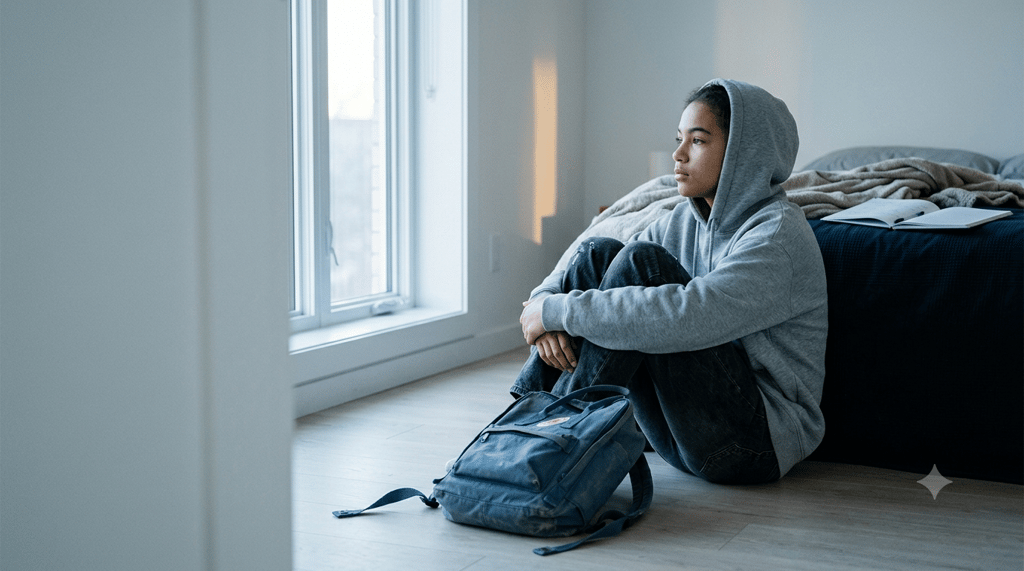
Signs Your Teen Needs a Different School: A Parent's Diagnostic Guide
For a year now you've been trying to answer one question, and you've been asking it of the wrong person.
It's Sunday afternoon, and the kid who was laughing at lunch has gone quiet on the couch. By dinner there's a stomachache. By bedtime they're asking again whether they can stay home tomorrow.
You know how the rest of the week goes, because you've watched it go this way for months. Monday is a negotiation. By Wednesday they're sleeping through the alarm and crying over a math test that isn't until next week. Then Friday loosens something, and Saturday morning hands you back the kid you recognize.
Everyone has a theory. The pediatrician asked about screen time. The counselor said "transition difficulties." Your sister-in-law says all teenagers are like this. But you've been keeping a quiet ledger in your head, and the pattern in it is too clean to be a phase.
So you ask the question every parent asks here: what's wrong with my kid? It's the intuitive question, and it's the wrong one. Some of the clearest signs your teen needs a different school have nothing to do with who your teen is. They live in the gap between this particular child and the place that child spends thirty hours a week — and that gap will keep looking like a kid problem right up until the environment changes.
What follows is the same pattern-matching a good clinician does, laid out so you can use it this week: what developmental psychology and mental health research say about that gap, and a table for telling environmental misfit apart from clinical depression. No blame here — not toward a school, a teen, or you. Just a better question than the one you came in with.
The Numbers Parents Are Living Inside
Begin with the American Psychological Association. In its 2014 Stress in America survey, 83% of teens named school as a significant source of stress — ranking it above family, above social life, above an uncertain future, and above their phones.
The mental health figures behind that ranking are familiar, but they're worth seeing together. The CDC's 2023 Youth Risk Behavior Survey found that 40% of high school students had experienced persistent sadness or hopelessness in the past year, up from 30% a decade earlier. One in five had seriously considered suicide; nearly one in ten had attempted it.
The clinical diagnosis data tells the same story from another angle. The 2023 National Survey of Children's Health counted 5.3 million U.S. adolescents aged 12 to 17 living with a diagnosed mental or behavioral condition. Anxiety diagnoses have risen 61% since 2016, depression diagnoses 45%.
In 2021, U.S. Surgeon General Vivek Murthy issued a formal advisory naming youth mental health a public health emergency. Emergency department visits for suspected suicide attempts among adolescent girls had climbed 51% in early 2021 against the same period in 2019. The advisory called for an "all-of-society" response spanning families, schools, technology platforms, and health systems.
Most public conversation about the cause settles on smartphones, and a later section weighs that case in both directions. But here's a figure worth setting beside the phone debate. Teens spend roughly 30 hours a week inside a school building, and somewhat less than that on their phones, depending on how the counting is done. The school figure is also a floor rather than a ceiling, because homework, anticipatory dread, and sleep lost to early start times all exist only because school does.
When the single largest environmental variable in a teenager's life is also the one they name most often as a stressor, that deserves a long look before the conversation turns to phones.
Is it normal for a teenager to dread school every day?
It's common, and increasingly so — but common is not the same as healthy. A teen whose dread tracks the school week, lifts on the weekend, and returns on Sunday afternoon is showing the empirical fingerprint of an environmental mismatch, not a personality flaw or a passing phase. The pattern carries more information than the dread itself.
Scale alone, though, tells you something is happening without telling you why. Plenty of forces move alongside rising teen distress: economic precarity, climate anxiety, political instability, family disruption, social media. School is one candidate among several, and naming it as a candidate isn't the same as proving it's the cause.
What the scale does establish is this. If your teen is anxious, withdrawn, missing more school than they should, or showing physical symptoms that follow the school calendar, you aren't looking at some idiosyncratic problem in your house. You're looking at a national signal, and your kid is one data point inside it. The sections that follow move from that scale toward mechanism.
The Engagement Cliff That Showed Up Right on Schedule
Gallup has polled American students on school engagement for more than a decade, and the headline finding barely moves. In fifth grade, 74% of students report being engaged in school. By high school, 33% do. The steepest single drop on the whole curve falls between sixth and seventh grade — which is why the signs that a teen needs a different school so often surface first in middle school.
That collapse from 74% to 33% is the measurable echo of something developmental psychology predicted back in 1993.
That year, Jacquelynne Eccles and Carol Midgley published a paper in American Psychologist with an unwieldy title — "Development During Adolescence: The Impact of Stage-Environment Fit on Young Adolescents' Experiences in Schools and in Families" — and a striking observation. Compared with the elementary schools that fed into them, American junior high schools scored higher on discipline and teacher control, and lower on student decision-making, on warm teacher-student relationships, and on intellectual challenge.
The pattern ran exactly backward. Adolescents are biologically entering the window when autonomy, identity, and competence become urgent psychological needs, and schools were meeting that moment by tightening control, depersonalizing relationships, and lowering their cognitive ambitions. Eccles called it a "stage-environment mismatch" and predicted the consequences: falling motivation, fading academic interest, declining mental health. Three decades later, Gallup has effectively been measuring that prediction at population scale, and the mismatch has hardened into the shape of a whole generation's school experience.
The mechanism Eccles described was later formalized by Edward Deci and Richard Ryan's Self-Determination Theory, among the most-cited frameworks in motivational psychology. It holds that human beings have three innate psychological needs:
Autonomy — meaningful choice over what you do, when, and how.
Competence — the regular experience of being capable, of making visible progress on something that matters.
Relatedness — being genuinely known by at least one adult and connected to peers in ways that go beneath the surface.
Meet all three and motivation and well-being rise together; thwart them systematically and both fall. Johnmarshall Reeve and Sung Hyeon Cheon have shown this inside classrooms specifically, and a 2022 systematic review by Yang and colleagues in Frontiers in Psychology, spanning 31 longitudinal studies and 20,804 participants, pinned down the direction of cause: autonomy support and need satisfaction predict rising classroom engagement over time, while teacher control and need frustration predict rising disengagement.
Set the three side by side and they interlock. Eccles named the mismatch in 1993, Self-Determination Theory explained the mechanism beneath it, and Gallup has been charting the consequence ever since. The philosopher David Deutsch offers a useful test for an explanation like this: a good one is hard to vary, meaning you can't change a piece without the whole thing falling apart. Alter the developmental window when autonomy needs emerge, alter the mechanism, or alter the Gallup curve, and the argument breaks. None of them have changed, and the shape holds.
Which points to a first diagnostic question. Thinking about your teen's actual environment — the building, the classrooms, the schedule, the people they're with all week — answer honestly:
- Does your teen have real choices about what they work on, and when, and how?
- Do they leave most days feeling capable, or feeling behind, dumb, or bored?
- Do they feel known by at least one adult at school, and connected to peers in some real way?
Two or three "no" answers, and the research predicts the very thing you're watching. The full framework comes later in this guide; this is the foundation it rests on.
A Quiet Argument From a Boston College Psychologist
In 2023, The Journal of Pediatrics published an unusual paper: "Decline in Independent Activity as a Cause of Decline in Children's Mental Well-being: Summary of the Evidence."
Its lead author was Peter Gray, a research professor of psychology at Boston College, writing with the anthropologist of childhood David Lancy and the developmental psychologist David Bjorklund. Their argument fits in a sentence. Over the past 50 to 70 years, children's opportunities for independent, self-directed activity have shrunk steadily; over that same stretch, rates of anxiety, depression, and suicide among young people have climbed sharply; and the two trends are causally linked.
What made the paper notable was where it ran. J Peds is a clinical journal read by pediatricians, not an advocacy outlet, and it doesn't traffic in manifestos. This argument went through peer review and landed in the literature that the doctors examining your child for stomachaches actually read.
Gray's wider thesis, developed across his book Free to Learn and a long-running Psychology Today column, runs through evolutionary anthropology. Humans evolved to learn through self-directed, mixed-age, playful activity in small bands, where children watched older children who watched adults. Compulsory, age-segregated schooling is, by that measure, brand new — roughly 150 years old across most of the developed world — and over the same period that schooling expanded and free play contracted, rates of generalized anxiety and major depression in American young people rose to something like five to eight times their 1950s levels.
This is convergent evidence rather than a controlled experiment, as Gray himself is careful to say. But the convergence is hard to ignore: evolutionary anthropology, cross-cultural childhood studies, longitudinal mental health data, and developmental psychology all point the same way.
A second strand of evidence has been accumulating quietly for forty years. The Sudbury Valley School in Framingham, Massachusetts, has run since 1968 as a fully self-directed environment, with no curriculum, no required classes, and no grades; students of every age decide how to spend their days. The alumni data is striking. In Gray and David Chanoff's 1986 follow-up in the American Journal of Education, 67 of 69 alumni surveyed reported being "very" or "moderately" glad they'd attended, and a substantial majority went on to college, including their preferred institutions. This isn't a randomized trial — Sudbury families select themselves, which limits how far the findings generalize — but four decades of consistent results, in an environment built around precisely the autonomy, competence, and relatedness that Self-Determination Theory says should produce well-being, is more than anecdote. It's a durable practitioner result with a theory that predicts it.
Put Gray's case beside the Eccles, Gallup, and Self-Determination work, and they converge on a single prediction: an environment that systematically denies autonomy, competence, and relatedness during the years those needs are most urgent will exact a predictable mental health cost. That cost is structural. It says nothing about teens being fragile, and it's exactly what the population data has been showing — and what some parents have been watching at home for years.
A Brief Word on the Phones Debate
By now a careful reader is wondering where Jonathan Haidt fits.
His 2024 book The Anxious Generation makes the most prominent popular case for a different cause of the crisis. The argument is twofold — the loss of play-based childhood and the rise of phone-based childhood, with a sharp inflection point around 2012 — and his prescriptions reach past phones to more childhood independence, restored free play, and phone-free schools. There's more overlap with the developmental-fit argument than the public discourse tends to admit.
The main counterweight comes from Andrew Przybylski at Oxford and Amy Orben at Cambridge. Their 2019 paper in Nature Human Behaviour, a specification-curve analysis of 355,358 adolescents, found that the correlation between screen time and well-being accounts for roughly 0.4% of the variance — smaller, as the Oxford team pointed out, than the negative effect of wearing glasses on adolescent well-being. Przybylski put it bluntly to Tes magazine: "What Jon is selling is fear. It's not scientific."
For the purposes of this article, the decisive point sits in the leftover. Even granting that skepticism in full, the 0.4% that phones explain leaves an enormous amount of variance unaccounted for, and that variance has to originate somewhere. The environment teens occupy 30 hours a week is the obvious place to look. Whatever phones are doing, school is both a bigger lever and a far more controllable one.
From "School Refusal" to "School Distress"
Until recently, clinicians described a teen who couldn't or wouldn't attend school as exhibiting school refusal. That term has been quietly retired. The current literature favors school distress and emotionally based school avoidance, usually shortened to EBSA.
The change can look cosmetic, but it marks a genuine clinical reclassification. Refusal implies a choice; distress and avoidance describe a response to an environment the teen experiences as truly unbearable. The field has, in effect, decided that most of these cases are a matter of can't rather than won't.
What is emotionally based school avoidance?
Emotionally based school avoidance, or EBSA, is the current clinical term for a child who cannot consistently attend school because of an overwhelming emotional response. It replaced "school refusal" because the older term implied choice. Most documented cases involve a teen reacting to an environment they genuinely cannot endure — often one that's failing to accommodate cognitive or sensory differences.
That reclassification rests on data. In 2023, Connolly and colleagues published the largest survey to date of children actively experiencing school distress in the UK, and the headline finding is the kind of number that reorganizes a parent's whole understanding of what they're watching: 92.1% of the children in school distress were neurodivergent, and 83.4% were autistic.
A significant share had been diagnosed after the distress emerged, not before — and the sequence is the whole point. Many of these teens went unidentified as neurodivergent until a conventional school environment pushed them past the limit of what they could mask.
Masking is the word parents of neurodivergent teens learn fast. Also called camouflaging, it means suppressing autistic traits to appear neurotypical: holding back stimming, modulating eye contact, performing scripts of conversational interest, damping down sensory complaints. Research summarized by clinicians across the UK and North America finds that masking is cognitively expensive — it burns through a limited daily reserve — and predicts burnout, depression, anxiety, and elevated suicidality. Autistic burnout in teens then tends to present in a way adults misread entirely: years of "doing fine," followed by a sudden, total collapse. The teen who abruptly can't get through the front door usually isn't falling apart in that moment. They've run out of the fuel it takes to keep performing the self the school demanded.
A parallel pattern appears in twice-exceptional, or 2e, profiles, where a gifted student carries a learning difference, ADHD, or autism alongside the giftedness. In a typical environment heavy on remedial work and light on cognitive challenge, these students face an odd double bind — understimulated intellectually while overtaxed socially and on executive demands, bored and frustrated at once. Both the Davidson Institute and a 2025 systematic review in Frontiers in Education flag that combination as a predictor of emotional outbursts, social withdrawal, and school refusal.
For sorting all this out, Christopher Kearney's work at UNLV offers a practical model. His functional approach identifies four reasons a child stops attending:
- To avoid stimuli that cause distress — sensory environments, particular classes, evaluative situations.
- To escape painful social or evaluative situations — peer dynamics, public performance, judgmental adults.
- To gain attention from caregivers — separation issues, attachment dynamics.
- To pursue tangible rewards outside school — gaming, hangouts, freedom from structure.
The first two functions are environmental, describing a child reacting to something happening at school; the second two describe a child reacting to something happening at home. The model is a sorting tool, not a substitute for clinical evaluation, but a parent who can name the dominant function in their own house knows more than they did before. And a teen who has been "fine" for years and then suddenly can't make it through the door is, in many cases, exactly what the research now expects — the shutdown being the body's last unambiguous message.
The Pattern That Tells You What You're Dealing With
The aim here isn't to replace a clinician. It's to hand parents the same pattern-matching a good clinician uses, so the conversations at home and in the doctor's office start out pointed in the right direction.
Why does my teen get stomach aches on school days?
When stomach aches cluster on school days and lift on weekends, the body is often voicing anxiety the teen can't yet name. Research finds 70% of children with anxiety disorders report stomach aches, and 67% with recurrent abdominal pain meet criteria for an anxiety disorder. The timing carries more information than the symptom itself.
Start with what the body is saying. A 2006 paper by Golda Ginsburg, Mark Riddle, and Mark Davies in the Journal of the American Academy of Child & Adolescent Psychiatry surveyed somatic symptoms in children with anxiety disorders and found that 70% reported stomachaches, 74% restlessness, 51% blushing, and 48% palpitations — with children over twelve reporting more such symptoms than younger ones, not fewer. In adolescence, the body often speaks before the words arrive. A separate 2009 paper by Dorn and colleagues in the Journal of Pediatric Psychology found that 67% of children with recurrent abdominal pain met the criteria for an anxiety disorder.
What parents are watching for isn't the presence of these symptoms — plenty of teens get stomachaches — but their schedule. Somatic complaints that gather on Sunday afternoon and weekday mornings, then measurably ease on weekends and over breaks. Dread that concentrates around particular classes, particular people, or particular transitions. The snow day that produces visible relief in a teen who's been miserable for weeks. When the "Sunday scaries" track the school calendar this precisely, they're doing real diagnostic work, because ordinary adolescent ambivalence about Monday doesn't produce stomach pain that vanishes on Saturday morning.
Is my teen depressed, or do they just hate school?
Clinical depression is persistent (over two weeks), pervasive across every context, and marked by anhedonia — lost pleasure in things the teen used to enjoy. Environmental school misfit, by contrast, improves measurably on weekends and breaks. The two often coexist, but the schedule of symptoms is the cleanest tell: depression doesn't take a holiday over spring break.
The contrast case, then, is clinical depression, and Cleveland Clinic and American Academy of Pediatrics guidance converge on its markers. It persists past two weeks. It shows up across contexts rather than only at school. It brings anhedonia, shifts in sleep and appetite, and a drop in concentration even in domains that have nothing to do with school.
The two conditions can also feed each other. A depressed teen in a wrong-fit school will look worse than either factor would produce alone, and environmental misfit can trigger or deepen clinical depression — which is why treating the depression while leaving the environment untouched so often yields only a partial recovery.
Here is the diagnostic table. Treat it as pattern-matching, not diagnosis. If most of your honest answers fall in one column, that's informative; if they split across columns, that's informative in a different way, and both readings matter.
| Pattern observed at home | Probably environment | Probably clinical |
|---|---|---|
| Mood drops Sunday afternoon, lifts Friday evening | Yes | Less likely |
| Symptoms persist across weekends and full school breaks | No | Yes |
| Specific dread of certain classes, teachers, or peers | Yes | Less likely |
| Anhedonia across all contexts, including past favorite activities | No | Yes |
| Somatic symptoms cluster around school mornings | Yes | Less likely |
| Concentration loss everywhere, including things they used to love | No | Yes |
| Sudden withdrawal after years of seeming fine (possible masking) | Yes — often neurodivergent | Possible |
| Visible recovery within 48–72 hours of a break starting | Yes | Less likely |
What you do with the answers depends on where they cluster. If most signs sit in the environment column, the productive next step is to examine hard whether the school is a good fit for this learner, rather than to conclude something is medically wrong with your teen. If most sit in the clinical column, schedule an evaluation this week. If they split, do both — environmental change without clinical support, or clinical support without environmental change, tends to under-deliver.
A note on finding a clinician. If the clinical column is winning, the American Academy of Pediatrics' HealthyChildren.org "Find a Pediatrician" tool can locate a doctor familiar with adolescent mental health, and the Child Mind Institute maintains a parents' resource directory and clinician finder. A pediatrician is a sound first call; the AAP recommends universal depression screening starting at age 12, so this should be familiar terrain for the doctor. A clinician who knows your teen is the one piece neither this article nor the school can supply.
For context, a population-level note. National chronic absenteeism doubled from 15% in 2018–19 to roughly 28% in 2022–23, and sat near 26% in 2023–24, with mental health the leading driver named in school-based health centers. The relationship runs both ways: anxiety drives absence, and absence deepens anxiety. A parent whose teen is missing school is no longer in unusual company — that company has simply grown enormous.
What the Transition Research Actually Shows
By now, the question most parents reading this haven't yet said out loud is the obvious one: should this teen move schools?
The honest answer is sometimes yes and sometimes no — and the difference is more predictable than the question makes it sound.
Can changing schools actually help a teen's mental health?
Sometimes. The transition research finds that a switch helps when the new environment scores measurably higher on autonomy, competence, and relatedness; when the family commits long enough for adjustment to take hold; and when the move targets a genuine fit rather than merely escaping the current school. Repeated switches without a real fit tend to do harm rather than good.
Take the evidence for transitions helping first. A 2023 systematic review by Bagnall and colleagues in School Mental Health synthesized the research and reached a finding that's mixed but useful: transitions can produce both positive and negative mental health effects, and social outcomes prove more amenable to intervention than psychological ones. In plainer terms, helping a teen build new relationships at a new school is more reliably effective than expecting the new building to repair a mood disorder.
A 2024 study by Engels and colleagues in the Journal of Youth and Adolescence looked specifically at peer transitions and identified what the authors called a "fresh start" effect. Students with negative primary-school peer histories — bullying, exclusion, persistently low status — benefited measurably from a change of peer pool, which resets reputation and relationships, and the benefit was largest for those who'd been victimized in the prior environment.
Outcomes data on alternative environments adds another angle. The Harvard "Flourishing" project, led by Tyler VanderWeele, has tracked the long-term effects of childhood environments, and a 2021 paper by Chen, Hinton, and VanderWeele in PLOS ONE compared adolescents who'd been homeschooled with peers from conventional schools. The homeschooled group went on to volunteer more, forgive more readily, report more sense of purpose, and engage in healthier behaviors, with mental and emotional health comparable to the conventionally schooled group despite lower average household income. The same paper also found them somewhat less likely to attend college — a finding worth naming as part of the full picture. The broader pattern lines up with comparative studies from the National Home Education Research Institute, which report homeschooled students showing lower rates of depression, fewer externalizing behaviors, and more positive self-image.
The limits matter just as much. A 2019 investigation in The Nation of LGBTQ+ youth who'd been homeschooled found significantly elevated rates of mental illness and suicidal ideation. The lesson isn't that homeschooling is good or bad; it's that homeschool outcomes depend entirely on who is doing it, why, and how — and the same caveat applies to any alternative environment.
On repeated school changes, the research is sharp. A 2014 analysis by Singh and Winsper in the Journal of the American Academy of Child & Adolescent Psychiatry, drawing on the British ALSPAC birth cohort, found that children who changed schools three or more times in early childhood carried roughly a 60% higher risk of psychosis-like symptoms by age 12 than peers who stayed put. Repeated upheaval does real damage. Outsider status, broken peer integration, and lost continuity compound on each other.
Pandemic-era data on virtual schooling deserves its own paragraph. A CDC analysis published in MMWR in 2022, drawing on January–June 2021 data, found that teens in fully virtual learning reported more stress, more persistent depression, and higher rates of suicidal ideation than peers in in-person or hybrid settings, with school connectedness and family connectedness softening the effect. The takeaway for any parent weighing an online environment now is direct: virtual settings aren't automatically better than the in-person ones they replace, and an online school that fails on those same three needs can be worse than the building it replaced. Design matters more than format.
Should I see a therapist before changing my teen's school?
Both paths work better run in parallel than in sequence. Environmental change without clinical support tends to under-deliver, and so does clinical care without environmental change. A clinician who knows your teen can help clarify whether the pattern is environmental, clinical, or both — and that clarity makes any school conversation that follows far more productive.
What predicts a successful change is consistent across the transition literature, and it comes down to three conditions. The new environment scores measurably higher than the current one on autonomy, competence, and relatedness. The family commits long enough — typically more than a single school year — for the new setting to take effect. And the move heads toward a positive fit chosen on its own merits, not just away from a bad one. Switches driven by pure escape, with no positive target, produce the worst outcomes. So the useful question is specific rather than binary: what, exactly, would a new environment do better, and is the match a real one?
Signs Your Teen Needs a Different School: What to Watch For This Week
The most useful thing any parent reading this can do before the weekend isn't to pick a school or call a therapist. It's to gather better data on what's actually happening at home.
Here are five observations to make, none of which needs more than a notebook and ten minutes a day.
Map the week. For seven days, write one line each evening — mood at three points (morning, after school, evening), any physical symptoms, energy level — and pay particular attention to Sunday afternoon, weekday mornings, the hour after school, and weekend mornings. The pattern usually surfaces faster than parents expect; three to five days is often enough.
Ask the three Self-Determination questions. Not as an interrogation, but in a quiet moment over dinner or before bed, ask versions of these:
- "Did you get any real choices today about what or how you worked?"
- "Did you feel like you could actually do the work today?"
- "Did anyone at school really see you today?"
Listen for the third answer your teen gives, not the first. The first is the script; the third is the data.
Watch the specifics. Is the dread general — a fog over the whole week — or does it attach to particular classes, particular people, particular times of day? Specific dread is environmental information; diffuse dread is something else. Both matter, but they point in different directions.
Run the weekend test. What happens on Saturday morning? What happens on day three of a school break? A teen who reliably becomes a different person 36 hours into a break is showing you what the school week costs them. A teen who stays withdrawn straight through spring break is pointing somewhere else — toward something the break can't reach.
Note what still lights them up. If a teen is miserable Monday through Friday but comes alive on Saturday afternoon for the thing they love, the capacity for joy is intact — which means something in the school week is suppressing it.
One thing to avoid: don't hand a teen this article and ask them to diagnose themselves. Teens, and neurodivergent teens especially, often can't articulate the source of their distress, and right now your observation matters more than their explanation.
One thing to do: if after seven days the pattern reads clearly environmental, schedule a real conversation with the school about specific accommodations or changes. Ask for something concrete, and watch closely how the school responds. Its willingness to actually change something — a schedule, a classroom, a workload, an accommodation — is itself a data point about fit. A school that answers with paperwork and process has told you one thing; a school that answers with a real change has told you another.
What a Fit-First Environment Can Look Like
If the diagnostic points toward environment, the next question follows naturally: what does an environment built around developmental fit actually look like in a teenager's Tuesday — not in theory, but in practice?
Autonomy shows up as real choice over what they work on, when, and how, with interests treated as entry points into rigorous content rather than distractions to be suppressed before learning can begin. Pop culture, video games, current events, a personal obsession — these become doorways into pre-algebra, into rhetoric, into chemistry, not things to put away first.
Competence shows up as work that produces something a teen can point to: a model, a podcast, an analysis, a pamphlet, a campaign. Mastery becomes observable because there's now a tangible thing where there wasn't one before.
Relatedness shows up as a setting small enough that adults know teens by name and by interest rather than by student ID and behavior log, where peer relationships form around shared work instead of hallway hierarchies.
Concretely, this can look like a middle-school class learning pre-algebra by tracking a simulated disease outbreak as medical detectives, where two-step equations and proportional reasoning emerge because they're needed to model the spread — an expedition that connects the 1854 cholera outbreak, the 1918 flu, and COVID-19. Or high schoolers studying the American Revolution by writing political pamphlets in the style of Thomas Paine's Common Sense, drawing their math from epidemiology and their rhetoric from Paine, so that the work itself becomes the content.
That school is Sora, an online, project-based, self-directed middle and high school — one example among others. The point isn't the brand; it's the shape. And the shape matters because it's what the research in this article predicts will work: an environment with real autonomy, observable competence, and named relationships is doing the three things Self-Determination Theory says have to happen for adolescent motivation and well-being. Whether developmental fit matters has been settled for thirty years. The open question is only whether a particular environment delivers it.
So if a teen is the one in the diagnostic table — Sunday-night stomachaches that lift on Friday, specific dread of specific classes, fully capable of joy on the weekend — and a parent wants to see what a fit-first environment looks like in practice, that's the conversation worth having. Not "apply now," not "schedule a tour," but a conversation about whether the shape of a different environment would fit this specific teen.
Where This Leaves You
The pattern in your house has names now: stage-environment fit, Self-Determination Theory, emotionally based school avoidance, a diagnostic table that separates environmental misfit from clinical depression, the transition research and its limits, and five observations to make this week.
What this article can't do is diagnose your teen, decide whether to change schools, or stand in for a long conversation with someone who knows your kid. Frameworks aren't diagnoses. A parent whose teen sits mostly in the environmental column should still talk to a clinician, talk to the school, and watch carefully through the weekend test; a parent whose teen sits in the clinical column should call a clinician this week.
What it can do is change the question — from "what is wrong with my kid" to "is the environment a fit." That shift sounds small, but parents who've made it tend to describe it as the one that changed everything that came after.
A teen struggling in a wrong-fit environment isn't broken, and a parent watching the struggle isn't failing. Both are responding to a mismatch the research has been describing for thirty years. Naming it is the first move; the rest follows from there.